1. The Identified Problem
External attack surface management (EASM) tools produce raw results: the same server counted once per DNS name, a visible exposure treated as a confirmed vulnerability, and prioritisation that is opaque or missing.
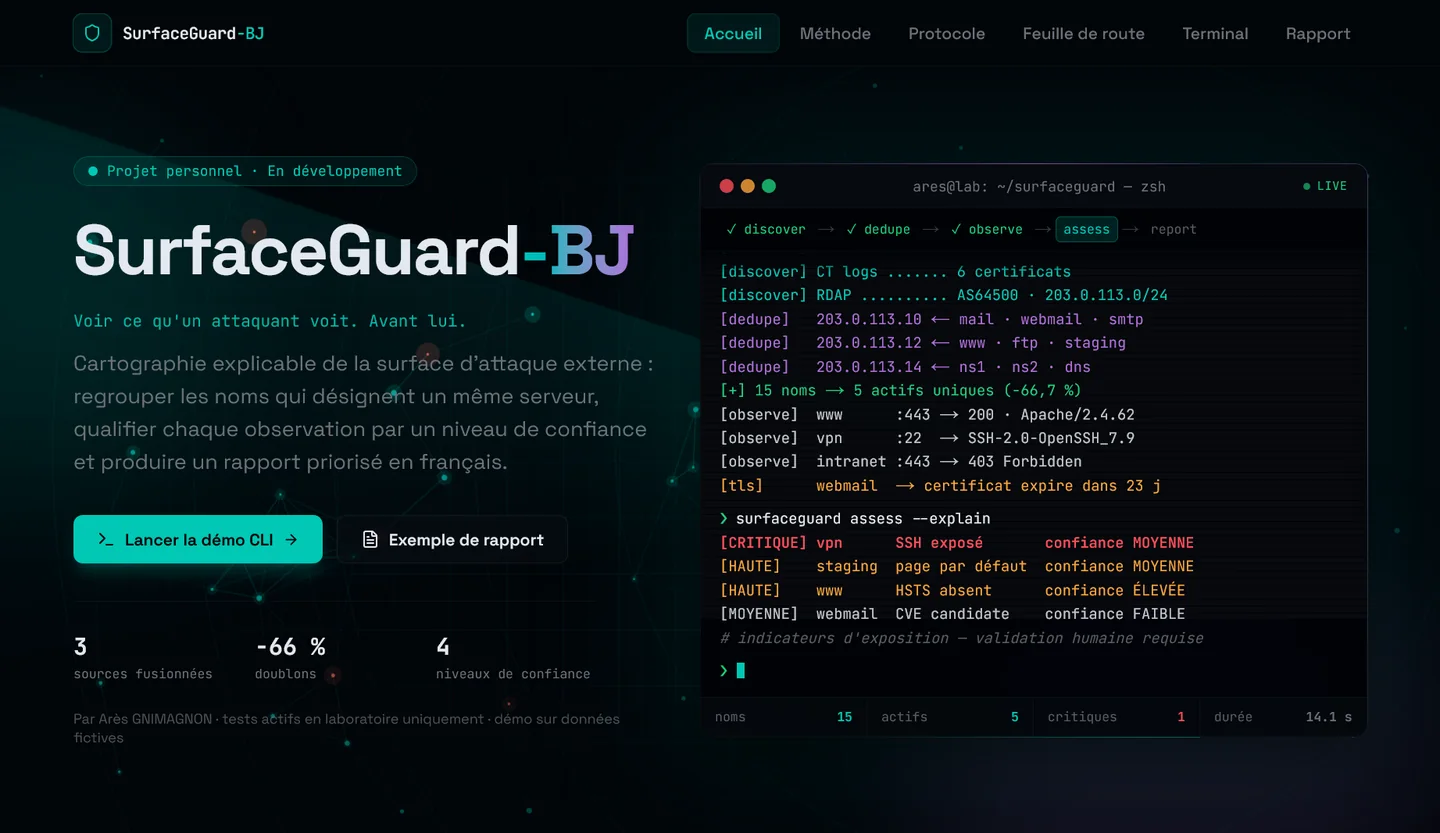
External attack surface management (EASM) tools produce raw results: the same server counted once per DNS name, a visible exposure treated as a confirmed vulnerability, and prioritisation that is opaque or missing.
A Python command-line tool that cross-checks passive sources (DNS, Certificate Transparency, RDAP), groups names that point to the same server, and gives each observation one of 4 confidence levels before ranking it with explainable criteria. Reports are written in French. Active testing is limited to a lab and to domains with written authorisation.
Live demo with fictitious data (reserved domains, documentation IP addresses and AS number), published method and roadmap. An exploratory, passive-only study compares the DNS visibility of government domains in 7 countries. The command-line prototype is in development.
Click any preview to inspect it in full screen view.